
Underwriting Support Is Becoming the Next Insurance Operations Priority
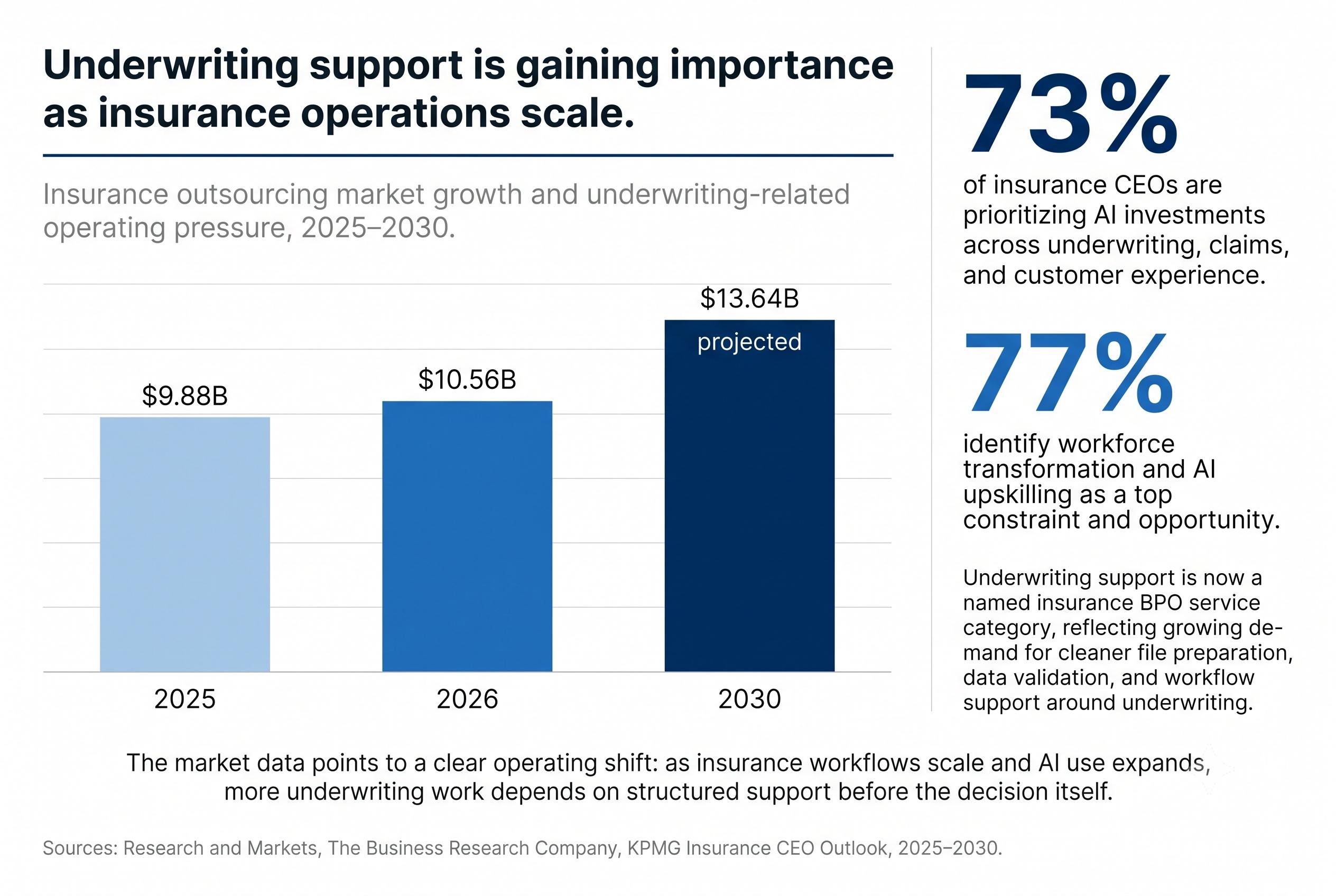


Underwriting support is moving closer to the center of insurance operations because growth, service speed, document quality, and workflow control now depend on how cleanly business moves before a policy is issued. That shift is visible in the outsourcing market itself. Research and Markets lists underwriting support alongside claims processing, policy administration, customer service, data entry, and document management as a core service type within the insurance BPO market. A separate Insurance BPO Services market report also segments the category by service type and includes underwriting support as one of the primary lanes of activity.
Underwriting Is Carrying More Operational Weight
Underwriting has always mattered, but the operating pressure around it has grown. KPMG’s 2025 Insurance CEO Outlook says 82% of insurance CEOs are confident in their company’s growth prospects, while 73% are prioritizing AI investments to streamline underwriting, claims, and customer experience. That combination creates a practical requirement for carriers: they need underwriting workflows that can move faster, absorb volume, and still preserve decision quality. Underwriting support has become part of that answer because it helps structure the work around the underwriter, not only the decision made by the underwriter.
This change also fits a broader operating pattern across the industry. Deloitte’s 2025 global insurance outlook says insurers are evolving operating models to become more agile, more customer centered, and better equipped to respond to changing expectations and technology demands. In practice, underwriting is one of the clearest places where those pressures meet. Application intake, data validation, document readiness, and quote support all affect how quickly and cleanly the business moves from submission to decision.
The Market Now Treats Underwriting Support as a Distinct Service Line
This is not just a process observation. The market data now reflects it directly. The Business Research Company defines the insurance business process outsourcing market as including revenues from services such as policy administration, claim processing, customer service, underwriting support, data entry, and document management. Research and Markets does the same in its 2026 BPO market report. When multiple market definitions isolate underwriting support as a named service line, that signals a category shift. Buyers are not treating underwriting assistance as a side task inside back office work. They are evaluating it as a defined operational capability.
That distinction matters for ISSI’s positioning. A carrier exploring underwriting support is usually not asking whether someone else can make underwriting decisions. The real question is whether a partner can help prepare, organize, validate, and route the work so underwriters can spend more time on judgment and less time on administrative drag. That is a very different value proposition, and it fits directly with how the market now describes insurance BPO services.
Throughput Improves Before the Decision Point
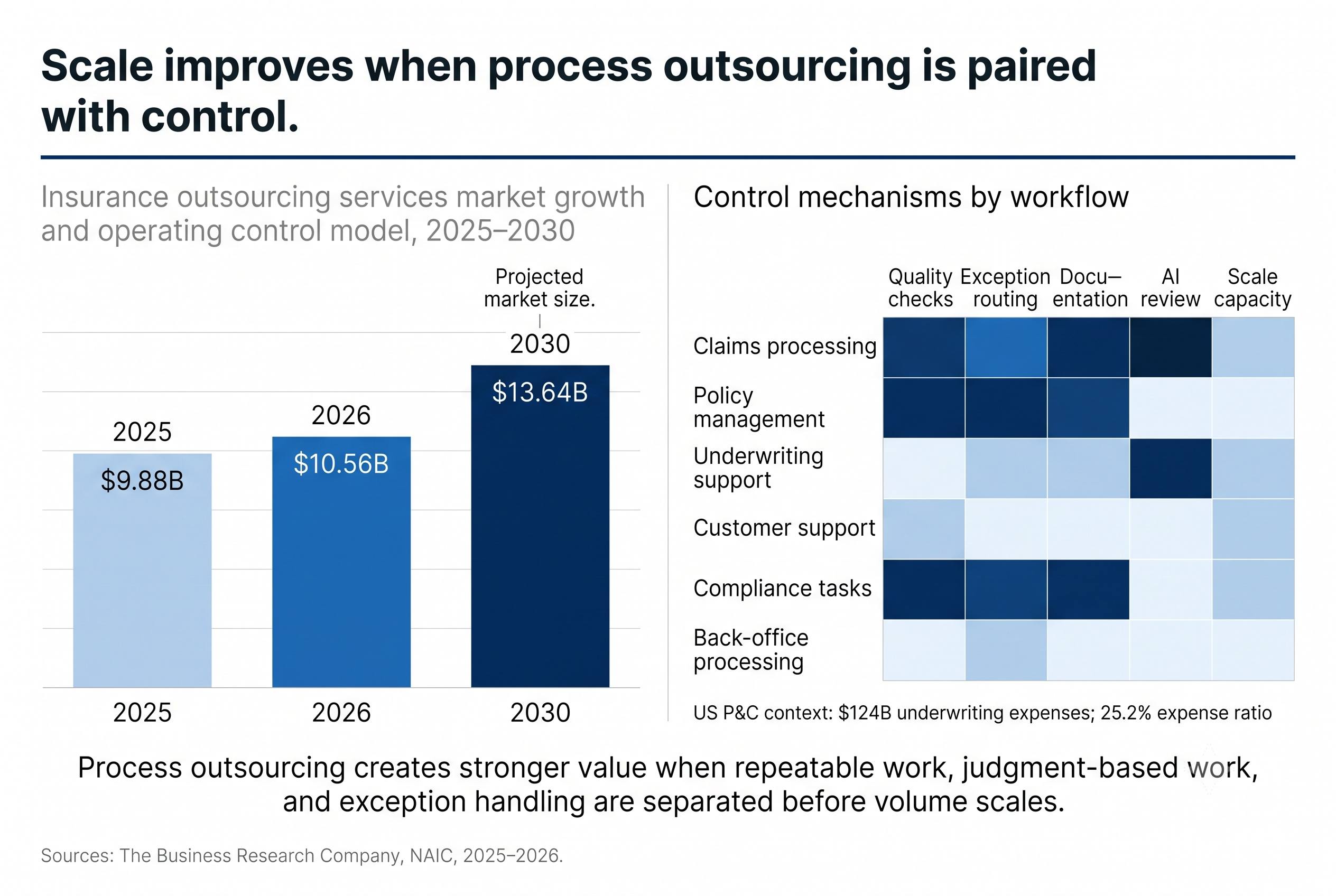
The strongest underwriting support models improve throughput before the decision point. That includes submission intake, document indexing, file preparation, data validation, exception identification, quote support, and handoff readiness. When these steps are structured well, underwriters receive cleaner files and spend less time reconstructing missing information. When they are handled poorly, delay starts early and spreads into service timelines, broker response, and policy issuance.
Research and Markets projects the insurance outsourcing services market to grow from $9.88 billion in 2025 to $10.56 billion in 2026, reaching $13.64 billion by 2030. The same report says forecast growth is being driven in part by increasing adoption of AI enabled underwriting support, stronger focus on scalable insurance operations, and rising demand for analytics driven decision support. That is a useful indicator of where the market is heading. Underwriting support is gaining value because it helps carriers move more work with greater structure around the decision process.
Data Quality and Documentation Now Matter More
Underwriting support has also become more valuable because the quality of the surrounding file matters more than before. EY’s 2025 Global Insurance Outlook says that regulatory change, evolving customer expectations, and the need for sophisticated tooling mean richer data and better supporting infrastructure now need to underpin the enterprise. That applies directly to underwriting operations, where file completeness, document quality, and clean data fields can affect turnaround time, consistency, and downstream policy accuracy.
The same logic applies to digital operations. A carrier may invest in better portals, AI assisted triage, or smarter quote workflows, but those tools still depend on how the submission is prepared and reviewed. If the input is weak, the technology simply processes weak input faster. That is one reason underwriting support is becoming more important as carriers modernize. The support layer helps create a cleaner operating environment for the tools the carrier is already trying to use.
AI Is Expanding the Need for Structured Support
The role of AI in underwriting makes this even clearer. KPMG says 73% of insurance CEOs are prioritizing AI investments across underwriting, claims, and customer experience, while 77% identify workforce transformation and AI upskilling as a top constraint and opportunity. Those numbers point to a simple operational reality. If underwriting becomes more AI assisted, then file readiness, exception routing, human review, and data quality become more important, not less.
Research and Markets also identifies AI enabled underwriting support as one of the forecast drivers of growth in insurance outsourcing services through 2030. That is an important signal because it ties underwriting support to a broader operating model rather than a narrow staffing need. The market is moving toward support structures that help carriers manage both volume and technology adoption at the same time.
Buyers Are Looking for Better Workflow, Not Outsourced Judgment
This is where many conversations about underwriting support go off track. Carriers are not looking to hand away underwriting judgment. They are looking to reduce the administrative burden around that judgment. Strong support shows up in file quality, document consistency, workflow discipline, and better handoffs. It helps separate repeatable work from review work. It creates more usable time for the underwriting team.
That distinction also makes the commercial search intent easier to understand. A buyer searching for insurance operations solutions, insurance BPO services, or underwriting support is often trying to solve for process flow, not only labor. The best content on this topic should reflect that. It should explain how underwriting support improves the operating model around the decision rather than implying that expertise is being replaced. That framing aligns much better with how current market reports describe the category.
What Carriers Should Evaluate
The practical evaluation criteria are straightforward. Can the model improve submission readiness. Can it identify missing information earlier. Can it support document quality and data validation. Can it route exceptions clearly. Can it keep the workflow moving when volume rises. These are the questions that determine whether underwriting support strengthens throughput.
The broader operating context supports that focus. KPMG’s CEO outlook highlights digitization, customer experience, AI adoption, and cyber resilience as top priorities for insurance leaders. All four touch underwriting in some form, because underwriting sits near the beginning of the policy lifecycle and affects how cleanly work moves into issuance, service, and future claims readiness. A support model that helps carriers manage that early-stage workflow more effectively has value well beyond the underwriting queue itself.
Closing Perspective
Underwriting support is becoming the next insurance operations priority because carriers are asking more of the underwriting workflow than they did a few years ago. The function now sits inside growth, service speed, digital modernization, AI adoption, and operating discipline at the same time. That makes the work around the underwriter more important, not less.
For insurers, the opportunity is practical. Better underwriting support can improve file readiness, reduce avoidable delay, and help decision making happen inside a cleaner operating structure. That is why the market is treating underwriting support as a distinct service line, and it is why this part of insurance operations is moving higher on the priority list.
Related Blogs
Rethinking your
operations
doesn’t have to
happen alone.
If these challenges sound familiar,
let’s explore where your operations can improve.