
Why Insurance Operations Solutions Need to Connect Front and Back Office Work
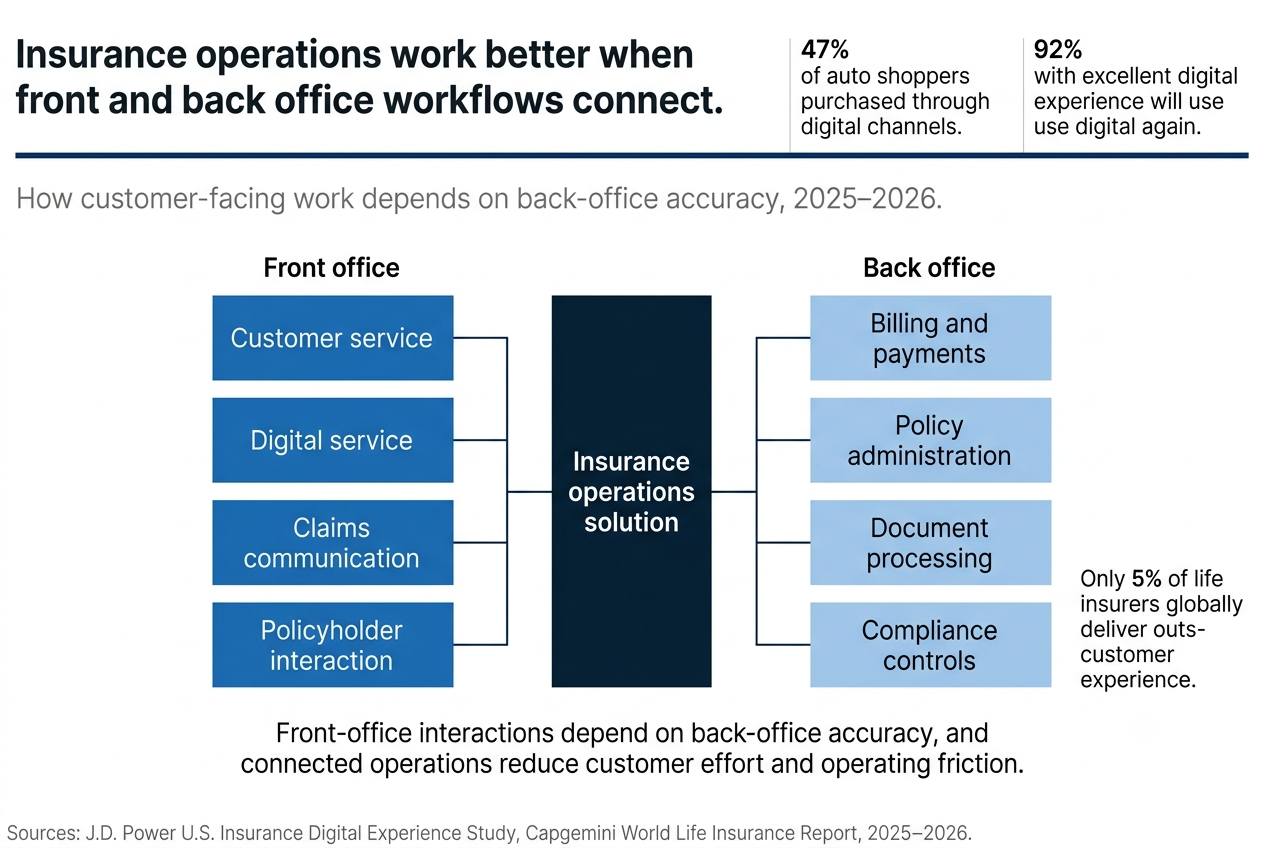


Insurance operations solutions are becoming more valuable because more of the customer and employee experience now depends on how well front office and back office workflows connect. The market is already moving in that direction. Research and Markets estimates the global insurance business process outsourcing market at $9.11 billion in 2026, up from $8.4 billion in 2025, and projects it will reach $12.36 billion by 2030. The category now includes policy administration, claim processing, customer service, underwriting support, data entry, and document management, which shows how carriers are evaluating operations as a connected system rather than a set of isolated functions.
The Customer Journey Crosses Both Sides of the Operation
A policyholder may begin with a billing question, move to a policy servicing request, ask for a document update, and later call about a claim. Those moments may look separate inside the organization, but the customer experiences them as one relationship. J.D. Power’s 2025 U.S. Insurance Digital Experience Study found that 47% of auto insurance shoppers now purchase through digital channels, compared with 35% through agents and 17% through call centers. That matters because once more of the journey starts digitally, the handoffs between service, policy operations, billing, claims, and document support become easier for the customer to notice.
The same study found that 92% of customers with an excellent digital experience say they definitely will use digital channels again, compared with 40% of customers with a poor digital experience. That difference is not created by interface design alone. It usually reflects whether the operating model behind the channel can deliver accurate information, clean next steps, and smooth escalation into assisted service when the request becomes more complex.
Front Office Activity Often Depends on Back Office Accuracy
A front office team can only move as cleanly as the back office information supporting it. When a representative explains a premium change, confirms a coverage update, or gives a claims status answer, they depend on data that may come from billing systems, policy records, claims files, document repositories, or compliance workflows. If one part of that chain is incomplete, the service experience slows down even when the representative does everything right.
This is one reason insurance operations solutions are becoming more important in commercial search. Buyers are not only looking for customer support or policy administration in isolation. They are increasingly looking for ways to improve the connection between customer facing work and the operating layer underneath it. Research and Markets and The Business Research Company both describe insurance outsourcing and BPO categories as covering document processing, regulatory compliance management, customer onboarding assistance, premium collection support, multilingual customer service, policy administration, underwriting support, and claims processing. That service mix points to a market that now treats front office and back office work as operationally linked.
The Economic Case Depends on Better Connection
This is also an efficiency issue. Capgemini’s World Life Insurance Report 2025 found that only 5% of life insurers globally deliver quantifiably outstanding customer experience, based on research with 6,186 customers in 18 countries and interviews with 213 executives across 16 markets. That small group achieved 38% higher Net Promoter Scores, 11% lower expense ratios, and 6% higher growth over three years. Capgemini ties those results to stronger coordination across onboarding, self service, servicing, and claims. In practical terms, better connection between the customer facing side of the operation and the processing side of the operation produces better economics as well as better experience.
The same pattern shows up in claims communication. J.D. Power’s 2025 U.S. Claims Digital Experience Study found that 22% of customers still rely on multiple channels to find answers to the same question, and customers who rate their digital claims experience as poor or just OK are far more likely to leave or not renew than those who rate it excellent or perfect. That is a visible example of what happens when status, communication, and workflow updates do not move cleanly across the operating model.
AI Makes the Connection More Important
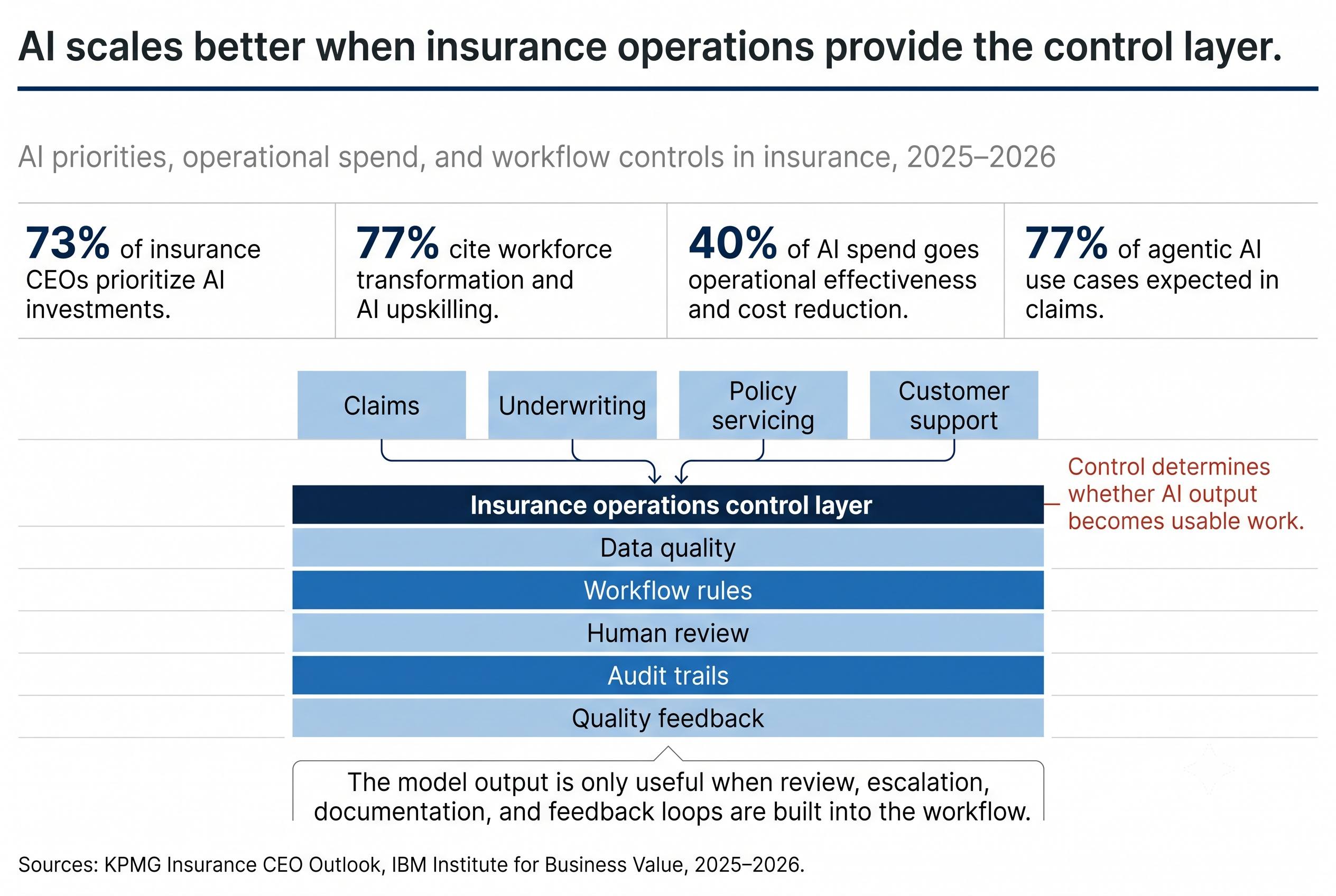
Technology is increasing the value of connected operations, not reducing it. KPMG’s 2025 Insurance CEO Outlook found that 73% of insurance CEOs are prioritizing AI investments to streamline underwriting, claims, and customer experience, while 77% identify workforce transformation and upskilling for AI as a top constraint and opportunity. Those numbers matter because AI outputs still depend on workflow design, data quality, escalation paths, human review, and documentation standards. If the front office and back office are loosely connected, the technology has less usable operating context.
This is where insurance operations solutions can create practical value. A claims summary generated by AI still needs usable claim file data. A customer service assistant still depends on billing, policy, and servicing records being current. A policy servicing workflow still needs document accuracy, exception routing, and auditability. The stronger the connection between customer facing activity and back office controls, the more useful the technology becomes in everyday work.
The Operating Model Has Become a Competitive Lever
KPMG’s outlook also found that insurance CEOs remain confident in growth, with 82% confident in their company’s growth prospects for 2025 and 83% focused on strengthening risk management and cyber resilience. That combination is useful context for this topic. Carriers are trying to grow, modernize, improve service, and manage risk at the same time. They need operations solutions that help them connect customer touchpoints, processing quality, governance, and workflow control rather than improving one piece while leaving the rest fragmented.
This is also why the phrase insurance operations solution has commercial value in Search Console. It reflects a buyer mindset that is broader than claims or support alone. The buyer is often looking for a model that improves how work flows across departments, how information moves across systems, and how quality is maintained as volumes, customer expectations, and technology complexity increase.
What Buyers Should Look For
The useful evaluation questions are operational. Can the solution connect policy administration, billing support, customer communication, claims updates, underwriting support, and document workflows clearly enough that teams do not create avoidable repeat work? Can it separate repeatable work from judgment based work? Can it keep the service layer informed while preserving back office controls around quality, compliance, and documentation?
Those questions matter more than broad claims about efficiency. A carrier usually feels the value of an operations solution when fewer interactions restart from the beginning, when status information is easier to access, when the document trail is more reliable, and when teams spend less time correcting work that should have moved cleanly the first time. That is the practical case for connecting front office and back office work.
Closing Perspective
Insurance operations solutions are becoming more valuable because front office and back office work no longer behave like separate systems. Customers move across channels. Employees depend on data from multiple workflows. Technology now sits inside both. The organizations that connect those layers more cleanly are in a better position to improve service consistency, workflow speed, documentation quality, and operating control.
For ISSI, this is a strong topic because it fits the way Google is already interpreting the site through commercial search. It also creates natural room to connect customer experience, claims and policy operations, back office support, compliance, and AI workflow control inside one credible operating narrative.
Related Blogs
Rethinking your
operations
doesn’t have to
happen alone.
If these challenges sound familiar,
let’s explore where your operations can improve.