
Insurance Customer Service Operations Are Becoming a Competitive Advantage


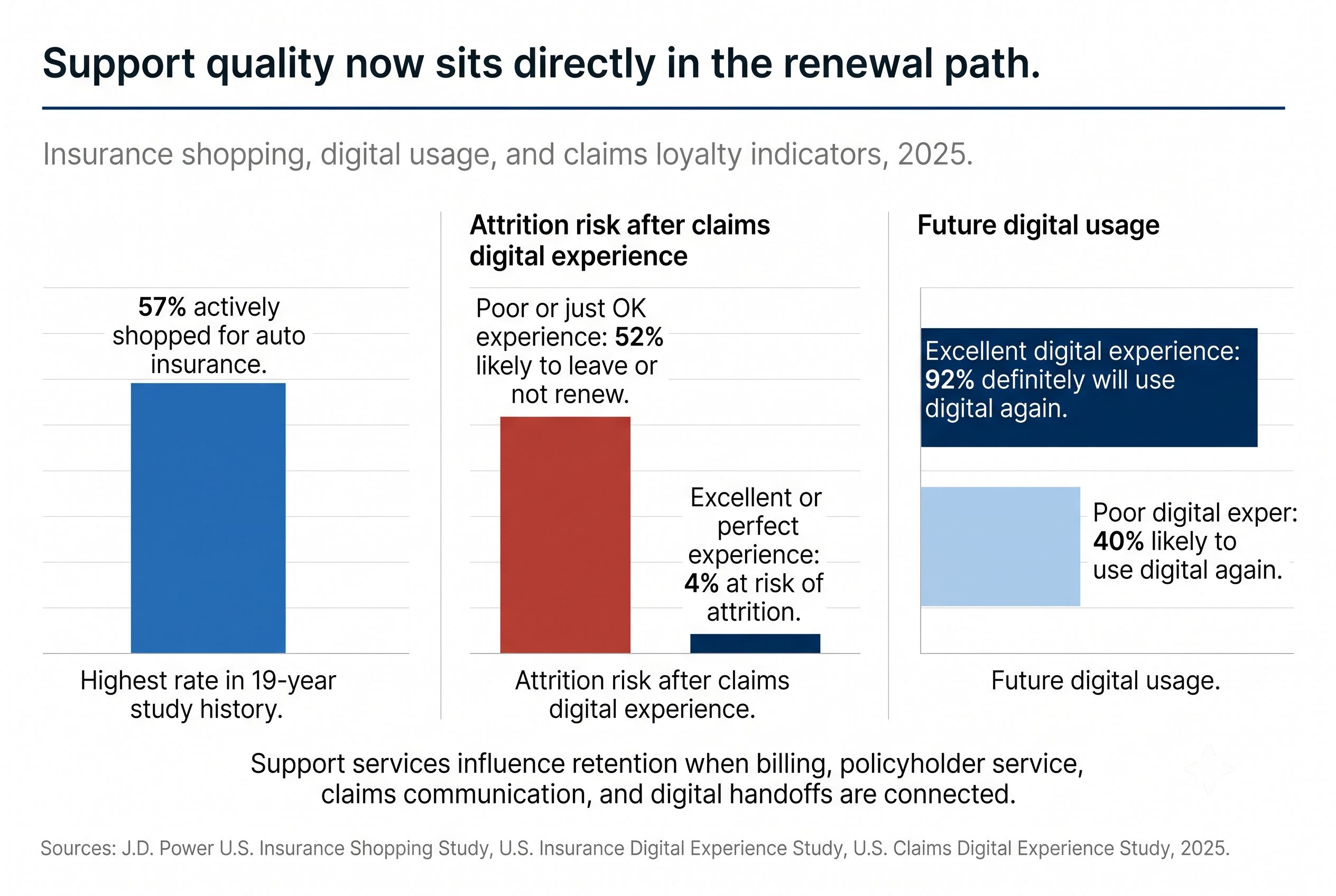
Insurance customer service operations have moved far beyond call handling. They now sit inside retention, digital adoption, claims communication, policy servicing, and renewal performance. That shift is visible in current market data. J.D. Power’s 2025 U.S. Insurance Digital Experience Study found that 57% of auto insurance customers actively shopped for a new policy in the past year, the highest shopping rate recorded in the study, and 47% purchased through digital channels. When more customers are comparing options online, every service interaction after the quote becomes part of the competitive position.
Customer Service Now Sits Closer to Revenue
A service organization used to be measured mainly by responsiveness. It is now judged by what it protects. Billing questions, endorsement requests, renewal changes, document issues, claim status inquiries, and coverage explanations all shape whether a policyholder feels the relationship is easy to maintain. J.D. Power’s 2025 U.S. Auto Insurance Study found that good rates and low cost remain the main reasons customers choose an insurer, while good service and a positive claims experience are the main reasons they renew. That is a direct operating signal. Customer service is no longer a support function sitting outside growth. It is part of how growth is retained.
This matters even more for high value accounts. The same study found that only 51% of high lifetime value customers say they definitely will renew with their current insurer, even though these customers usually carry more policies, higher premiums, and longer tenure. Service consistency now has financial weight because the most valuable customer relationships are often the most operationally demanding.
Digital Adoption Has Raised the Service Standard
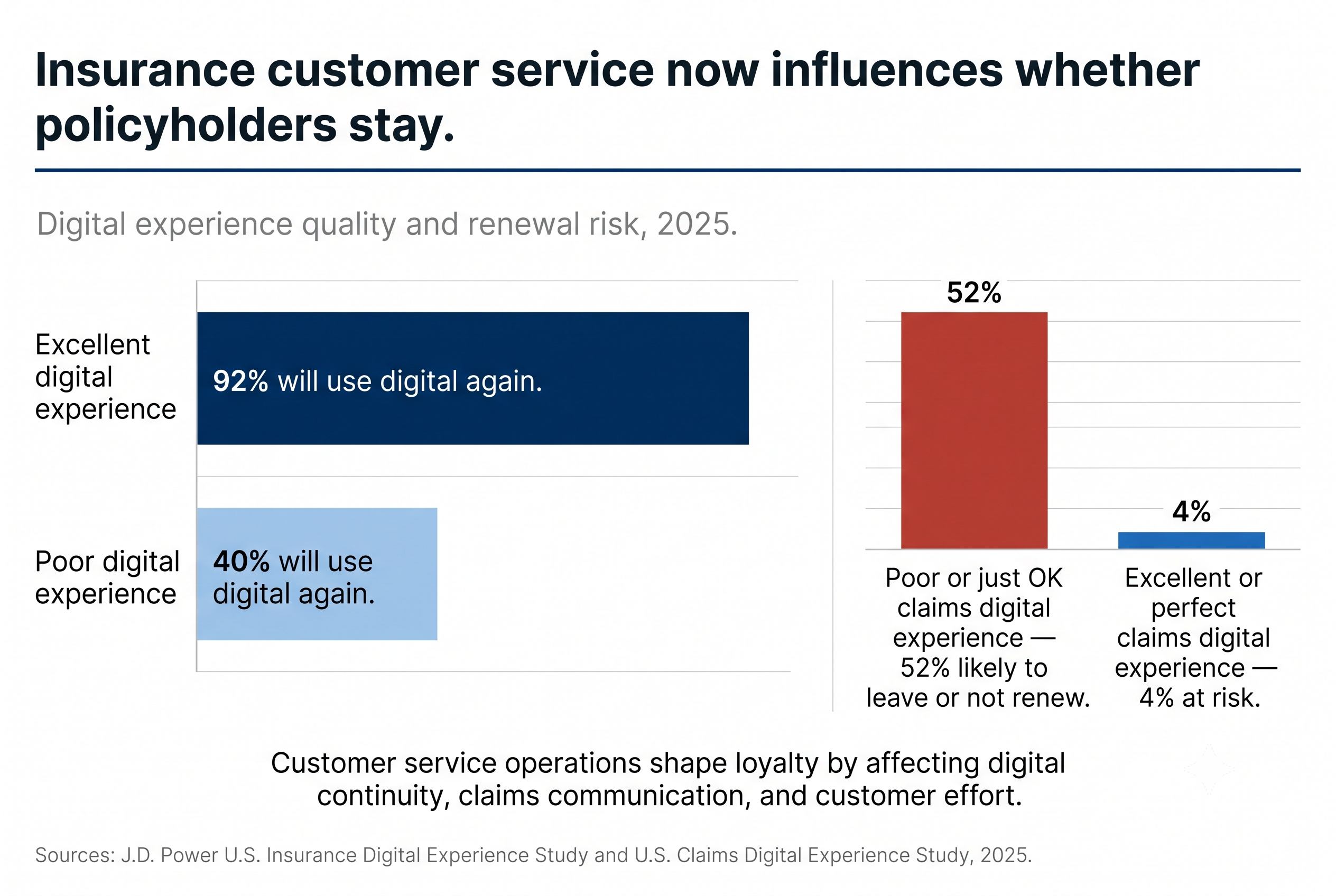
Digital channels have become the primary front door for many policyholders, but digital growth has not reduced the importance of customer service operations. It has raised the standard those operations have to meet. J.D. Power found that 92% of customers who have an excellent digital experience say they definitely will use digital channels again, compared with 40% of customers who have a poor digital experience. The implication is straightforward: the digital interface can attract and retain engagement, but only if the underlying service model gives customers accurate answers, clear next steps, and clean handoffs when self service is not enough.
That is where insurance customer service operations have become more demanding. A customer may start in an app, move to chat, then need a representative who can see billing history, policy details, prior communications, and claim status without restarting the conversation. The service model succeeds when the channel shift feels continuous. It fails when the policyholder has to repeat information or wait while teams search across disconnected systems.
Claims Communication Has Become a Retention Issue
Claims service is one of the clearest examples of how customer service operations influence loyalty. J.D. Power’s 2025 U.S. Claims Digital Experience Study found that 22% of customers still rely on multiple channels to find answers to the same question. The same study found that 52% of auto and homeowners customers who rate their digital claims experience as poor or just OK are likely to leave or not renew, compared with 4% among those who rate the experience excellent or perfect.
Those numbers point to a very practical lesson. Customers do not separate service from operations. They judge the experience as one connected interaction. If a claims status request requires three follow ups, if documentation is incomplete, or if updates are inconsistent across phone, app, and email, the customer does not experience that as a workflow issue. They experience it as uncertainty. Strong customer service operations reduce that uncertainty by giving service teams clear status visibility, approved communication guidance, and escalation paths that work in real time.
Insurance Service Work Is More Connected Than It Looks
Customer service in insurance looks straightforward from the outside. Answer the question. Send the document. Update the policy. Explain the bill. In practice, even routine interactions can touch policy administration, billing, claims, producer support, compliance requirements, and renewal logic. A customer calling about an address change may also need updated documents, revised payment timing, and confirmation that future notices will be delivered correctly. A policyholder asking about a claim may need status detail pulled from adjuster notes, payment records, or missing documentation queues.
That operating complexity is why service quality cannot be measured by volume alone. Average handling time and calls answered are still useful, but they do not show whether the interaction was resolved cleanly. The stronger measures are first contact resolution, repeat contact rate, reopened cases, escalation rate, correction volume, and quality findings tied to downstream work. These metrics show whether the service operation is reducing customer effort or simply moving the work to another team.
The Economic Context Makes Service Discipline More Valuable
The service discussion is also happening inside a tighter expense environment. NAIC’s 2025 mid year property and casualty analysis reported $124 billion in underwriting expenses, a 25.2% expense ratio, and a 96.4 combined ratio for the first half of 2025. That means customer service operations matter for two reasons at once. They influence loyalty on the front end, and they influence operating efficiency on the back end. Repeated contacts, manual corrections, poorly routed inquiries, and delayed follow up all add cost even when they are invisible on a traditional service dashboard.
This is where customer service operations become a competitive advantage rather than a support necessity. Carriers that build cleaner service workflows can protect renewal intent while reducing avoidable work across billing, policy servicing, claims support, and compliance review. The value is operational first, but the commercial effect follows quickly.
What Strong Insurance Customer Service Operations Look Like
The strongest models usually share the same traits. They give representatives better context at the point of contact. They define when an inquiry can be resolved immediately and when it should move into a controlled workflow. They use quality review to identify where repeat contacts begin. They make digital and human channels work together instead of competing with each other. They also treat customer service as part of the broader insurance operating model, not as an isolated function.
This is why many carriers are rethinking service alongside policy servicing, claims support, workflow control, and back office operations. As digital usage rises and policyholders compare carriers more actively, the service team is often the part of the organization customers experience most often. A well designed operation helps customers get answers faster, reduces unnecessary handoffs, and keeps service quality consistent even when volume rises.
Closing Perspective
Insurance customer service operations are becoming a competitive advantage because they now shape how policyholders experience the carrier after the sale. The operational details matter more than ever: whether the billing answer is clear, whether the claims update is visible, whether the digital path works, and whether the representative can resolve the issue without creating more work somewhere else.
The opportunity for carriers is practical. Treat customer service as part of the operating model that supports retention, claims communication, policy servicing, and digital performance. The organizations that do this well are not simply answering more contacts. They are reducing customer effort, protecting loyalty, and turning service consistency into an advantage the market can feel.
Related Blogs

Rethinking your
operations
doesn’t have to
happen alone.
If these challenges sound familiar,
let’s explore where your operations can improve.