
Why Insurance Outsourcing Solutions Are Expanding Beyond Claims
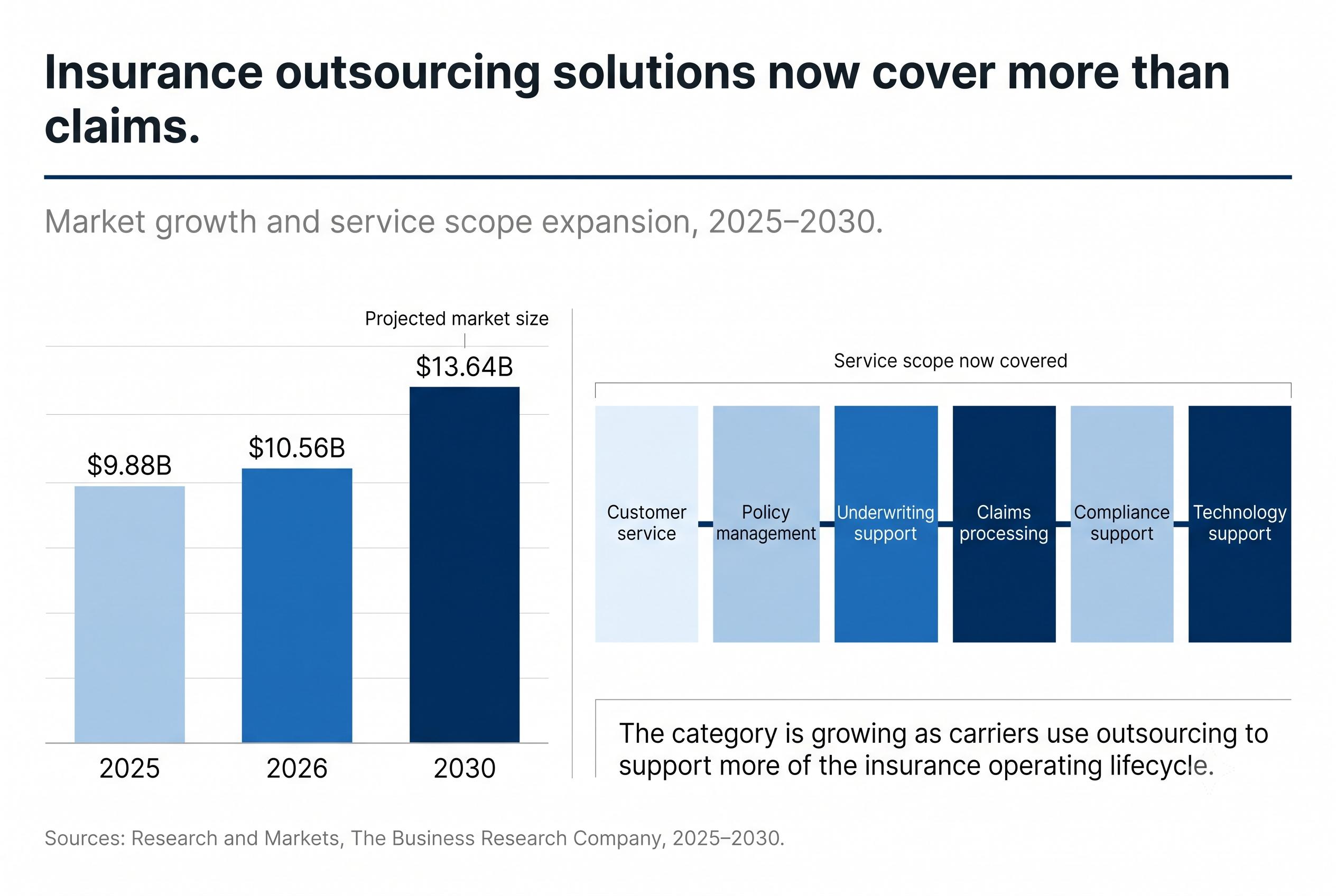


Insurance outsourcing solutions used to be discussed mainly through the lens of claims processing. That is no longer an accurate picture of the category. Current market reports describe insurance outsourcing as a broader operating model that now includes policy management, underwriting support, finance and accounting, information technology, compliance support, customer onboarding, billing support, multilingual customer service, document processing, and data conversion. The market is growing alongside that expansion. Research and Markets projects the insurance outsourcing services market at $10.56 billion in 2026, up from $9.88 billion in 2025, with a path to $13.64 billion by 2030.
The Operating Pressure Is No Longer Concentrated in Claims
Claims still matter because they are highly visible and emotionally charged, but carriers are managing pressure across much more of the operating lifecycle. KPMG’s 2025 Insurance CEO Outlook says 82% of insurance CEOs are confident in company growth, while 73% are prioritizing AI investments across underwriting, claims, and customer experience, and 83% are focused on strengthening risk management and cyber resilience. That combination tells a simple story: operational pressure is now distributed across service, policy, underwriting, technology, and governance, not isolated inside one function.
That broader pressure changes what buyers look for in insurance outsourcing solutions. A carrier may need support in claims intake, but it may also need help with renewal servicing, onboarding, billing support, compliance documentation, data handling, or workflow controls around AI enabled processes. Once the operating challenges become connected, the outsourcing model has to become connected as well.
Policy Management Has Moved Closer to the Core
One of the clearest signs of this expansion is the amount of policy work now included in outsourcing categories. Current market definitions include policy issuance, renewal management, cancellation handling, endorsement processing, policy information updates, customer onboarding assistance, premium collection support, and billing related services. That matters because policy administration is not back office work in the abstract. It directly affects customer communication, document accuracy, payment timing, and future claims readiness.
For carriers, that means policy operations are now part of the same conversation as outsourcing scale and service consistency. A customer asking for proof of coverage, a billing clarification, or an endorsement update is experiencing the carrier through the quality of its policy workflow. If those workflows are supported well, the outsourcing model strengthens both service and operating discipline. If they are loosely connected, the work comes back later as repeat contact, corrected documents, or downstream review.
Customer Experience Has Made Service Operations More Important
Customer service operations are another reason insurance outsourcing solutions are expanding beyond claims. J.D. Power’s 2025 retention material points to communication quality during claims as a major driver of satisfaction and loyalty, with a large satisfaction gap between customers who say communication with representatives is very easy and those who do not. That same logic applies beyond claims. Service clarity, billing support, onboarding help, and policy servicing now carry more weight because customers interact with insurers across more channels and expect continuity across those touchpoints.
This is where outsourcing has changed from a capacity discussion into an operating discussion. Multilingual customer service, onboarding assistance, premium collection support, and billing support now show up directly in market segmentation for insurance outsourcing services. Those are not fringe categories. They are evidence that carriers increasingly view outsourced support as part of the customer experience layer, not simply an administrative backstop.
Underwriting Support Has Become Part of the Same Conversation
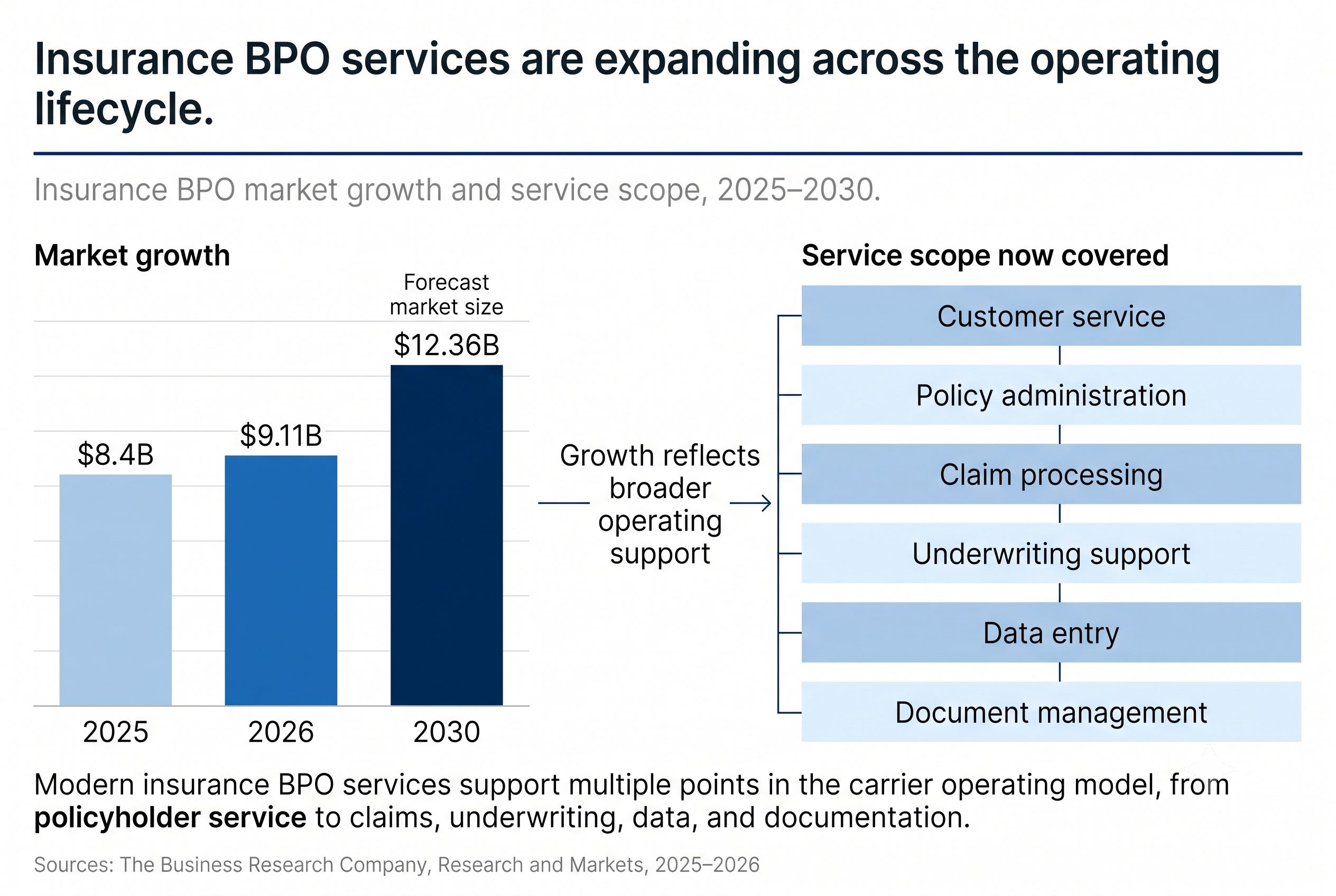
Underwriting support is another area where the category has broadened. Insurance BPO market definitions now include underwriting support alongside claims processing, policy administration, customer service, data entry, and document management. That shift matters because underwriting capacity affects response times, document review speed, application handling, and quote support, all of which shape how quickly the carrier can convert business and maintain service quality.
The operational value here is not that underwriting judgment is being replaced. It is that surrounding work can be structured more effectively. Data validation, document preparation, screening support, and file readiness all improve the throughput of underwriting teams when they are handled with clear controls. That is one reason the insurance outsourcing market increasingly includes underwriting support in the same category as policy and claims work. Buyers are looking for operating models that improve flow across functions, not just within them.
Technology Has Expanded the Provider Role
Technology has widened the scope of insurance outsourcing solutions even further. The Business Research Company now includes legacy system modernization, telematics integration, cybersecurity services, information technology infrastructure support, platform maintenance, and data conversion within the outsourcing market. Research and Markets also points to growing specialization and the consolidation of administrative functions across claims, underwriting support, policy administration, compliance, and customer engagement.
That matters because carriers are trying to run increasingly digital operations while maintaining service quality and governance. The provider relationship is now expected to sit inside a more modern operating environment that includes analytics, automation, workflow management, and security controls. In that context, insurance outsourcing solutions are expanding beyond claims because the technology layer now touches nearly every operational function the carrier is trying to improve.
Governance and Risk Are Pulling More Work Into the Model
Another reason the category is broadening is governance. KPMG reports that 83% of insurance CEOs are focused on risk management and cyber resilience, while its 2025 outlook also highlights the pressure created by AI adoption, workforce readiness, and operating change. When governance expectations rise, the outsourcing model has to support documentation, quality review, escalation rules, and operational visibility across more workflows than before.
This is why compliance support, fraud monitoring assistance, audit support, and knowledge process services are now part of how the market is described. The provider is not being evaluated only on whether work gets completed. It is being evaluated on whether the work can be completed cleanly, documented correctly, and managed within the carrier’s control environment. Once that becomes part of the buying criteria, claims can no longer be the only center of gravity.
What Buyers Should Actually Look For
The best way to evaluate insurance outsourcing solutions today is to look at how the provider supports connected workflows. Can the model handle policy work, service work, claims support, underwriting support, documentation, and governance with consistent process discipline. Can it distinguish repeatable work from judgment based work. Can it support digital operations without creating extra handoffs or repeat contact. These are more useful questions than asking only how much claim volume the provider can absorb.
This is also where commercial intent in search becomes useful. A buyer searching for insurance outsourcing solutions is rarely looking only for a claims vendor. The search itself often reflects a broader need for operating support. That is why the strongest content on this topic should explain how outsourcing now touches policy, service, underwriting, data, compliance, and workflow management in addition to claims. The category has already moved there. The content should reflect that reality.
Closing Perspective
Insurance outsourcing solutions are expanding beyond claims because insurance operations themselves have become more connected. Policy servicing affects retention. Underwriting support affects speed to quote and readiness. Customer support influences loyalty. Compliance and documentation shape control. Technology now sits inside all of it. As carriers continue balancing growth, service quality, efficiency, and governance, the outsourcing model is being asked to support more of the operating lifecycle.
For insurers, the opportunity is practical. A broader outsourcing model can improve flow across the work that customers and employees experience every day, not only the work that appears after a loss. That is why the category is growing, and it is why the next generation of insurance outsourcing decisions will be made across claims, policy, service, underwriting, and operations together.
Related Blogs


Rethinking your
operations
doesn’t have to
happen alone.
If these challenges sound familiar,
let’s explore where your operations can improve.